Series
From the six-layer core loop to agentic self-correction - a complete breakdown of every RAG pattern, when each earns its complexity, and how to decide which one you actually need.
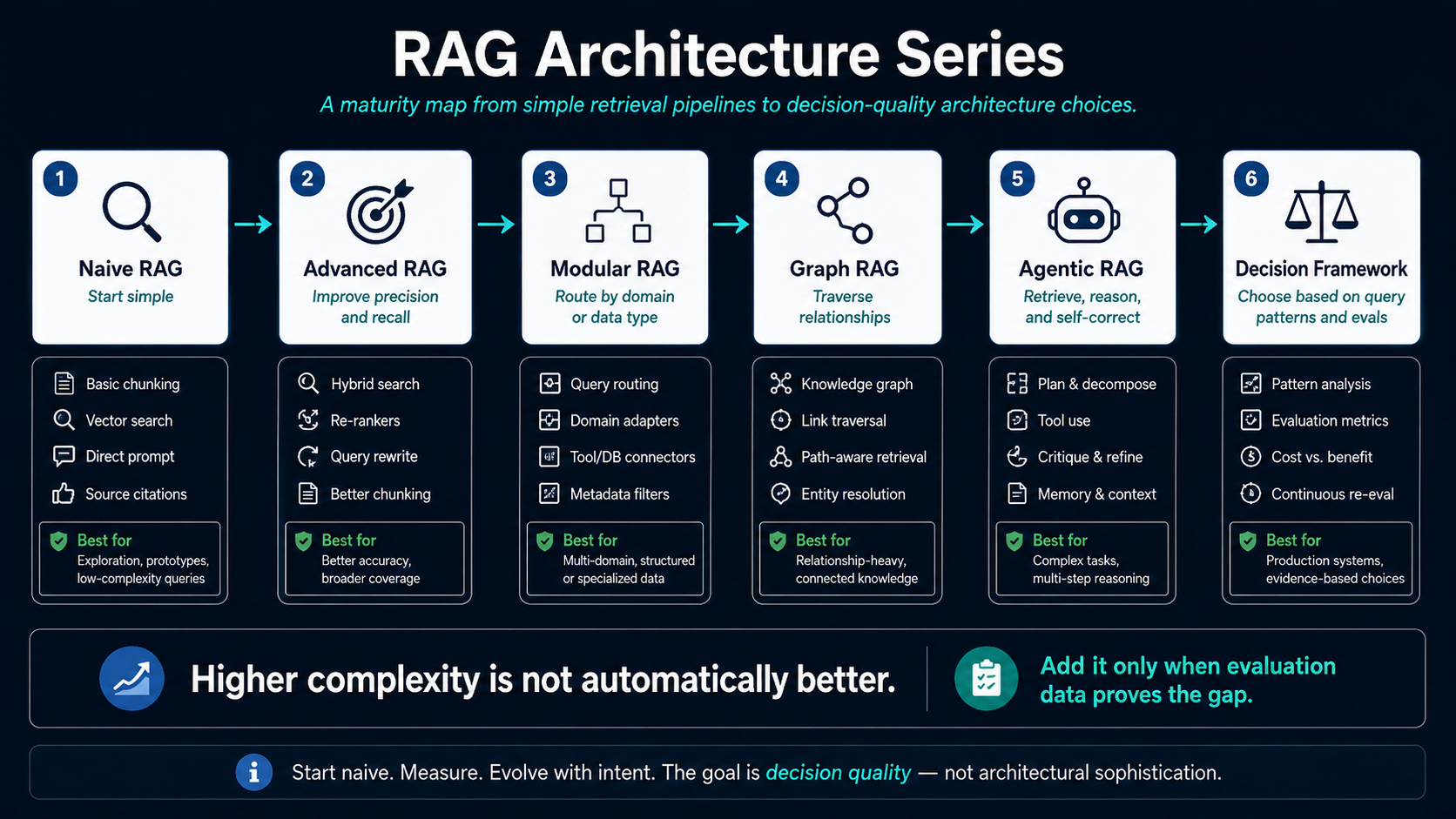
A good RAG system is not defined by retrieval alone. It is defined by the architecture around it: query understanding, context selection, evidence quality, evaluation, governance, and production behavior. This six-part series breaks down the major RAG patterns - from naive RAG to advanced, modular, graph, and agentic RAG - with architecture diagrams and engineering reasoning for each. You will not just learn what each pattern is; you will learn when it earns its complexity, what it costs to add, and how to choose the right design using evaluation signals instead of architectural hype.
Click to enlarge
The six-layer model that maps each RAG stage to a specific failure mode - and why Advanced, Graph, and Agentic patterns all add components inside this same architecture.
Read →Build naive RAG first. Instrument it with real eval data, then add complexity exactly where the numbers show a gap - not because a more sophisticated pattern sounds impressive.
Read →Query rewriting, Reciprocal Rank Fusion, cross-encoder reranking, and HyDE - the pre- and post-retrieval techniques that directly target precision and recall.
Read →Modular RAG routes queries across distinct data domains. Graph RAG traverses entity relationships. Two structural patterns that solve fundamentally different problems.
Read →The Reason → Act → Observe → Evaluate loop, self-correction with CRAG, and the non-negotiable guardrails - max iteration limits, cost ceilings, full tracing - for production agentic RAG.
Read →A plain-language decision tree, scale-tier guidance from under 50K to 1M+ documents, and the four eval metrics - context precision, recall, faithfulness, answer relevance - that actually matter.
Read →