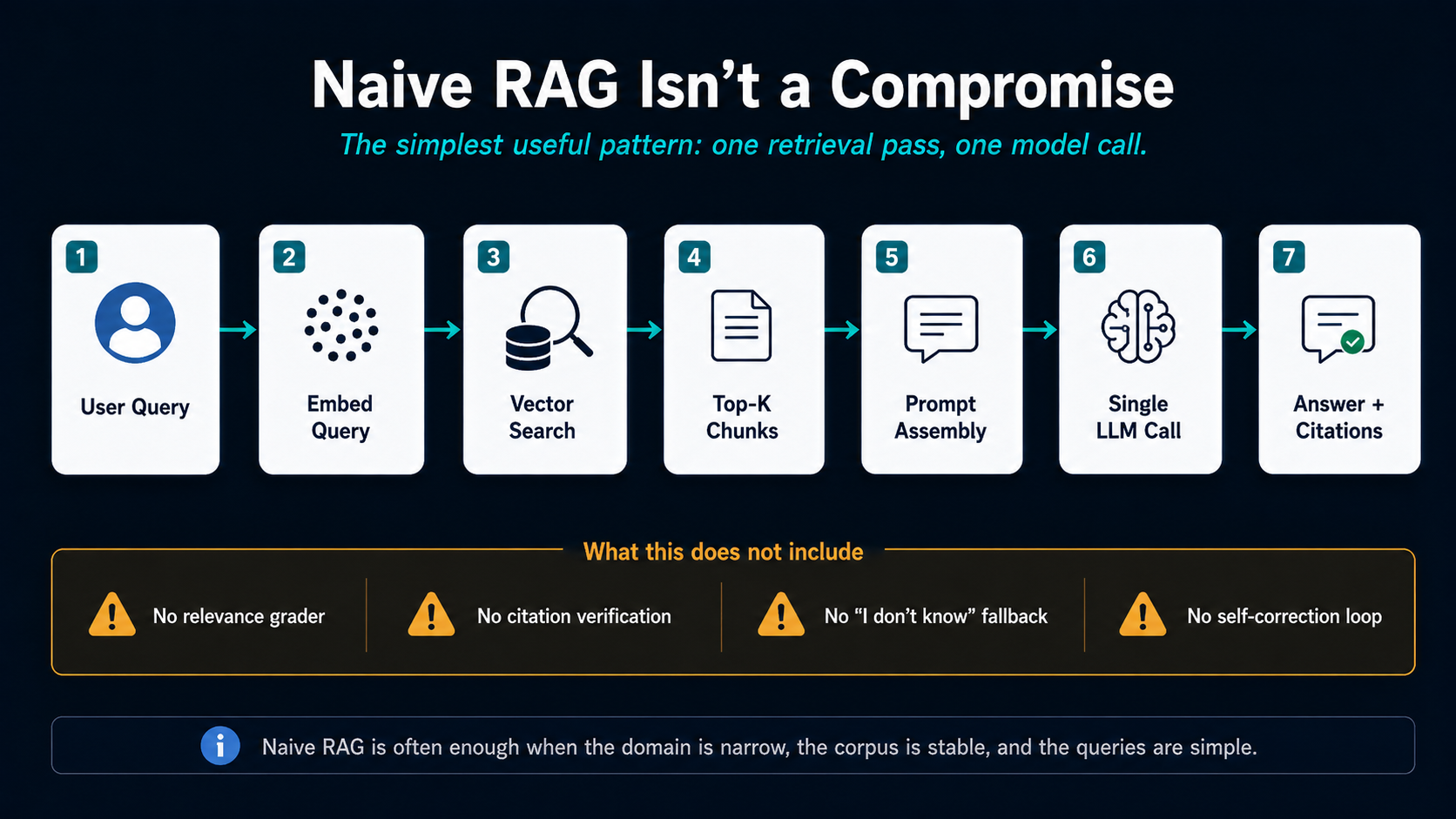
Naive RAG usually follows one direct path: question, retrieve, add context, generate. It is fast to build, easy to understand, and often sufficient for a focused use case with a clean, reasonably homogeneous document collection.
Its simplicity also makes it the best baseline for evaluation. You cannot measure the value of a more complex pattern without first knowing how the simple one performs.
Click to enlarge
When to use it
A single-pass retrieval pipeline is the right choice in several common situations. If you are validating whether RAG addresses the use case at all, naive RAG lets you answer that question quickly without infrastructure investment. If questions are mostly direct and single-step, a more sophisticated retrieval pipeline may add complexity without meaningfully improving results. If content comes from one primary domain with consistent structure and language, the conditions that break naive RAG are less likely to appear. And if you need retrieval behavior that is easy to inspect and explain, a simple pipeline is far easier to debug than a multi-stage one.
When it starts to fail
Four signals indicate that naive RAG has reached its limits. Exact terms and identifiers are missed: semantic search finds conceptually similar passages but may miss a specific error code, product SKU, or clause number that the user actually needs. Important results rank below irrelevant ones: the top-k retrieval returns passages that are related but not the most directly useful, and nothing in the pipeline corrects this. Questions are ambiguous or multi-part: a single embedding of an ambiguous or compound question cannot capture all the information the answer requires. Several data sources must be searched differently: when the right retrieval strategy depends on the question type, a single fixed pipeline cannot adapt.
What the baseline needs to prove
A well-configured naive pipeline retrieves 5-10 passages from an over-fetched candidate set of 20-25, evaluated against a representative sample of 50-100 real questions. Two metrics determine whether the baseline is working. Context recall measures whether the expected passage appears anywhere in the candidate set - if it does not, no downstream technique can recover it. Answer faithfulness measures whether the generated response is supported by what was retrieved - if faithfulness is low despite adequate recall, the problem is in context construction or generation, not retrieval pattern. A baseline that achieves context recall above 0.80 and faithfulness above 0.85 on a representative sample is not a system to replace. It is a system to measure against before deciding whether a more complex pattern is justified.
Simple is not the same as careless
A basic system still needs the same operational requirements as a more advanced one. Document-level permissions must be enforced so retrieval respects access boundaries - a naive retriever is not exempt from security. Citations must be attached so answers can be verified against their sources. The system must have an explicit abstain path for when the retrieved evidence is insufficient to answer; returning the nearest vector is not the same as having an answer. And the pipeline must be evaluated against real questions before it goes live, not after users encounter failures.
Naive RAG is a deliberate starting point, not a placeholder. It defines the baseline every subsequent improvement is measured against.
Is your baseline good enough to move on?
Enter scores from your evaluation run. This tells you whether to add complexity or fix the foundation first.
Remember: build the baseline before adding architecture. A more complicated system is not automatically a more accurate one, and you cannot measure improvement without knowing where you started.